
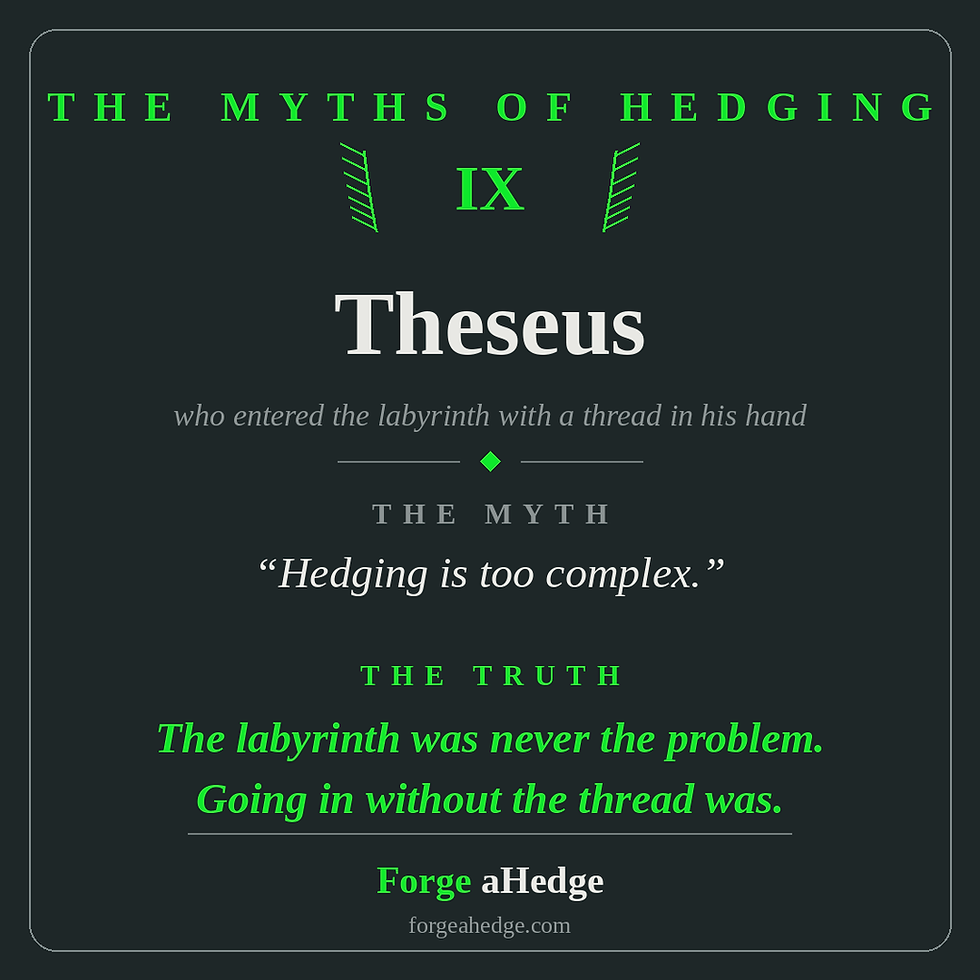
Hedging myths IX - "Hedging is too complex"
Theseus volunteered to enter the Labyrinth on Crete and kill the Minotaur, a monster that was half man and half bull. Ariadne, the daughter of King Minos, fell in love with Theseus and gave him a sword and a ball of thread. Theseus tied the thread at the entrance so he could find his way back through the maze. He killed the Minotaur and escaped by following the thread.
Fascinatingly, the modern word ‘clue’ originates from the Middle English ‘clewe’, meaning a ball of thread, a reference to the ball of thread Ariadne gave Theseus to escape the Labyrinth.
The labyrinth was never the problem. Going in without the thread was.
The labyrinth was designed by Daedalus to be unsolvable. This final myth is partially true: commodity exposure identification, policy compliance, hedge accounting documentation, effectiveness testing, mark-to-market mechanics — commodity hedging can be complex. Yes, it can be a labyrinth, but that's not a reason to stay outside, to stay exposed to volatility.
Theseus never understood the maze; he didn't map it, and he didn't need to. He needed a route in and a route out. Risk managers don’t need to calculate every potential cashflow for a commodity swap; they need a system that automates the analysis and guides them. Treasurers don't need to derive the hedge accounting standard from first principles; they need a simple documented path through it. They need Forge aHedge, Ariadne’s ball of thread.
This is the last of our series where we called on ancient Greek heroes and heroines to dispel hedging myths. At Forge aHedge we strive to help companies navigate volatility and secure profits with intelligent, AI native technology.
As always, let's Forge aHedge!